Transitions & Generic Paths
# Copyright 2026 Helge Gehring, Simon Bilodeau and contributors.
# Licensed under the Apache License, Version 2.0.
# ---
# jupyter:
#   jupytext:
#     text_representation:
#       extension: .py
#       format_name: percent
#       format_version: '1.3'
#   kernelspec:
#     display_name: Python 3
#     language: python
#     name: python3
# ---
Transitions & Generic Paths
Designing complex photonic or RF circuits often requires smooth transitions between
different waveguide widths or custom paths defined by mathematical expressions.
gdswell provides a flexible API for defining these transitions and paths.
Cross-Section Transitions
You can transition between any two CrossSection objects. This will interpolate
the widths and offsets of all layers present in the cross-sections.
The transition method supports:
Linear interpolation: The default behavior.
Custom functions: Use SymPy expressions (like
S**2for parabolic) to define the interpolation profile.
from enum import Enum

import sympy

import gdswell as gw
from gdswell.components.bend_circular import bend_circular
from gdswell.components.generic_path import generic_path
from gdswell.components.straight import straight
from gdswell.cross_section import CrossSection, LayerSection, S


class Layers(gw.Layer, Enum):
    WG = (1, 0)
    CLADDING = (2, 0)


# Define two cross-sections for the transition
xs_narrow = CrossSection(
    (
        LayerSection(name="core", layer=Layers.WG, width=0.5),
        LayerSection(name="clad", layer=Layers.CLADDING, width=3.0),
    )
)

xs_wide = CrossSection(
    (
        LayerSection(name="core", layer=Layers.WG, width=2.0),
        LayerSection(name="clad", layer=Layers.CLADDING, width=5.0),
    )
)
Linear and Parabolic Tapers
Let’s create a cell that demonstrates different types of tapers.
@gw.cell
def taper_demo() -> gw.Cell:
    c = gw.Cell()
    length = 10.0

    # 1. Linear Taper
    xs_linear = xs_narrow.transition(xs_wide)
    taper_lin = straight(cross_section=xs_linear, length=length)
    c.add_ref(taper_lin, origin=(0, 0))

    # 2. Parabolic Taper
    # f(s) goes from 0 to 1 as s goes from 0 to length
    xs_parabolic = xs_narrow.transition(xs_wide, f_s=S**2)
    taper_para = straight(cross_section=xs_parabolic, length=length)
    c.add_ref(taper_para, origin=(0, 10))

    return c


taper_demo()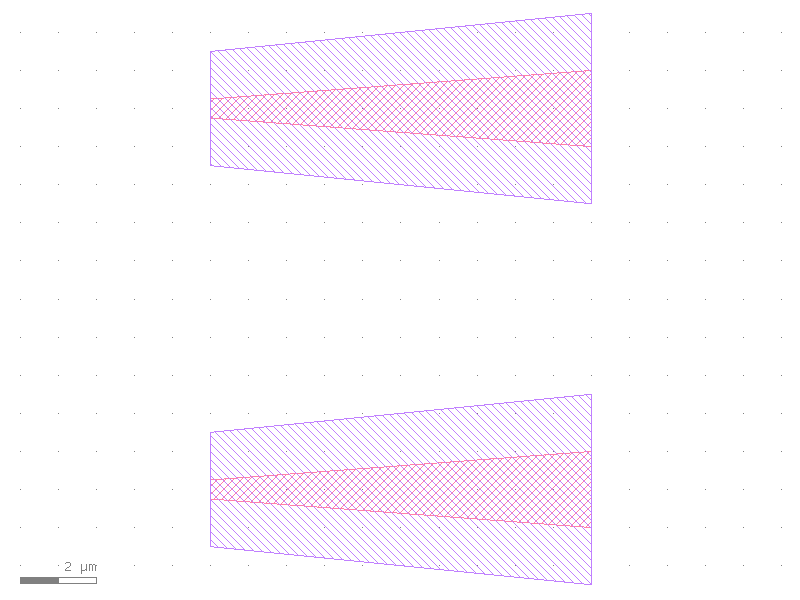
Generic Paths (Sine Wave)
You can define custom paths using SymPy expressions for and , where is the parameter that represents the path progress from 0 to 1.
@gw.cell
def sine_demo() -> gw.Cell:
    c = gw.Cell()

    # x(s) and y(s) as functions of S (from 0 to 1)
    x_expr = 20 * S
    y_expr = 2 * sympy.sin(2 * sympy.pi * S)

    sine_wg = generic_path(cross_section=xs_narrow, x_expr=x_expr, y_expr=y_expr, npoints=200)
    c.add_ref(sine_wg)
    return c


sine_demo()FutureCell(running=False)Tapered Bends
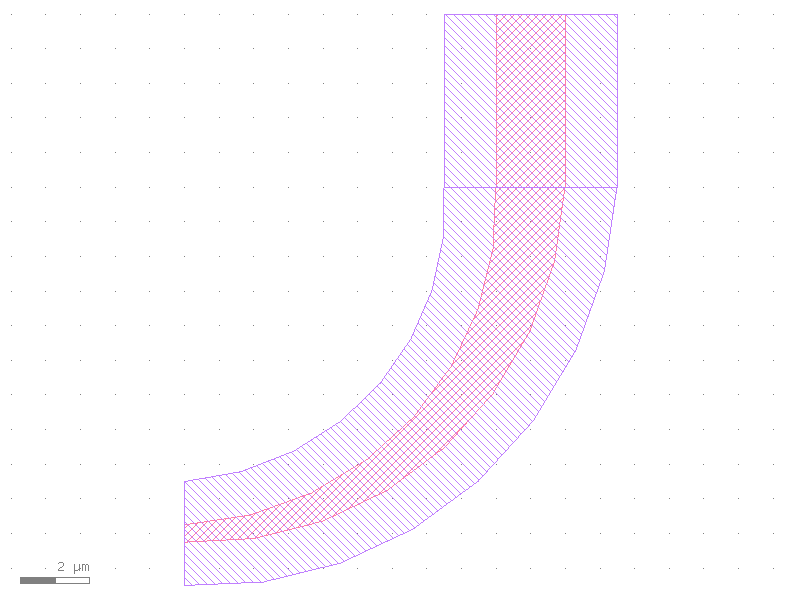
Transitions can also be applied to curved components like bends.
@gw.cell
def tapered_bend_demo() -> gw.Cell:
    c = gw.Cell()

    xs_bend = xs_narrow.transition(xs_wide)
    t_bend = bend_circular(cross_section=xs_bend, radius=10.0, angle=90.0)

    # The bend's ports will also have transposed cross-sections
    # Connect a wide straight to the outputs
    s_end = straight(cross_section=xs_wide, length=5.0)

    inst_bend = c.add_ref(t_bend)
    c.add_ref_connected(s_end, port_name="0", target_port=inst_bend["1"])

    return c


tapered_bend_demo()